Most couples come to the dinner question thinking about food. Which pasta, which fish, how many courses, what the vegetarian guests will eat. Those questions matter, and a good Italian kitchen will answer every one of them beautifully. There is, however, a decision that comes before the menu, and it shapes the evening far more than any single dish: how the food reaches the table.
A plated dinner, a family style wedding dinner and a dinner built around food stations can share the same chef, the same ingredients, even the same recipes. They will still feel like three different weddings. One keeps the room seated and in rhythm. One turns every table into a conversation. One gets people on their feet and moving.
There is no right answer here, and I would be wary of anyone who tells you otherwise. What works depends on who you are inviting, where you are getting married and what kind of evening you want to remember. What I can do is show you what each choice changes, so you can decide with your eyes open.
Three Ways to Serve a Wedding Dinner
Plated is the format most people picture when they think of a formal wedding. Each guest receives a dish composed in the kitchen, every table is served the same course at the same moment, and the waiters clear in sequence before the next course arrives.
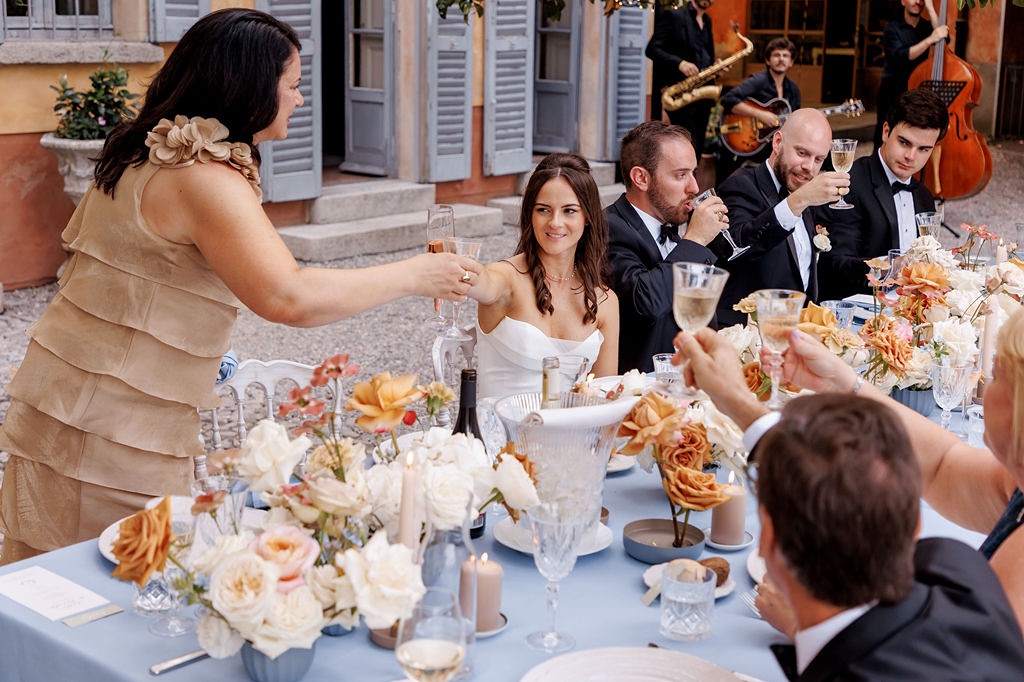
Family style means shared dishes. Large platters and bowls are set in the middle of each table, and guests serve themselves and pass the food along. Waiters still bring each course, refill the platters and clear, but the serving happens between the guests.
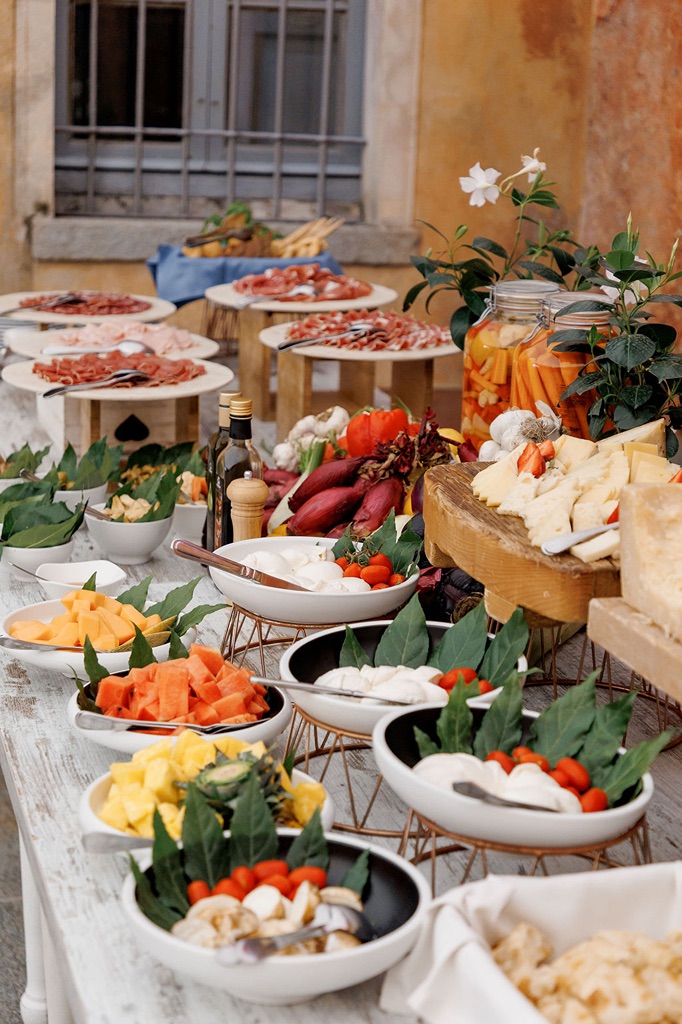
Stations are dedicated points around the space, each with its own offer: a raw bar, cheeses and cured meats, a chef finishing fresh pasta or slicing to order. Guests get up, choose, and come back to their seat, or don’t sit at all. Think of it as a buffet with more care, and often with someone cooking in front of you.
Family Style: The Italian Sunday Table at a Wedding
For many of the couples I work with, family style feels like a discovery. For Italians, it is simply how we eat when the people we love are around the table. Sunday lunch at a grandmother’s house, long summer dinners that start before sunset and end well after midnight: food in the middle, everyone reaching, someone always insisting you take a little more.
Brought to a wedding, that habit changes the atmosphere of each table. Passing a dish is a small gesture, yet it makes people talk. Guests who met an hour earlier at the aperitivo end up serving each other, comparing notes on the burrata, asking for the bread. Your college friends and your cousins from another continent stop being two separate groups much faster than they would with a plate each in front of them.
The pace changes too. A family style wedding dinner tends to move more slowly, because people linger over the platters and nobody feels rushed to finish before the next course. If you want a dinner that feels generous and unhurried, this is the format that gets you there most naturally.
A family style wedding menu does need to be designed for sharing. Some dishes travel well from a platter: roasted vegetables, sliced meats, whole fish filleted at the table, risotto served from a large pan, salads, cheeses. Others are at their best composed on the plate and eaten immediately, such as delicate fresh pasta with a sauce that has to reach the guest within seconds, or dishes with several elements that lose their balance when spooned out. A good caterer will build the menu around this, and sometimes the answer is to serve one course plated and the rest family style.
Plated: When the Evening Needs a Rhythm
Plated service has a reputation for being the stiff option. In practice, it is often the most considerate choice, and there are evenings where nothing else works as well.
It gives the evening a rhythm. When every table receives the same course at the same moment, it becomes easy to place speeches, toasts or a first dance between courses without anyone being caught mid-bite or halfway to a station. If your evening has several moments that need everyone’s attention, plated service holds them together.
It also handles dietary requirements with more precision. When guests come from different countries, the list of allergies, intolerances and preferences can be long. With plated service, each guest receives exactly the dish that was prepared for them, and nobody has to ask what is in the platter in front of them.
And it respects the clock. Some venues, particularly historic villas, have firm limits on music and end times. Plated service is the format that keeps dinner within the timing you planned, which leaves the rest of the evening for dancing.
Stations: Movement Instead of a Seat
Stations turn dinner into something closer to a party. Guests stand, wander, talk to people at other tables, come back to their seat with a plate and a new story. For couples who want energy and mingling more than ceremony, that movement is the whole appeal.
Many couples frame it as plated vs buffet, and the honest answer is that stations shine in certain moments more than others. They are wonderful during the aperitivo, when guests are already standing and the light is changing over the lake or the hills. They work beautifully late at night, when people want something to eat between dances. And they suit the more relaxed events of a wedding weekend, a lunch by the pool or a casual welcome evening.
As the main dinner for a large guest list, they ask for more planning. Queues form easily if there are too few points of service, guests who are less mobile end up waiting while others serve themselves, and the room can feel scattered at the moments when you want everyone together. Stations can still be the right call; they simply need careful design: enough points, enough staff and a clear idea of when guests are meant to sit.
What Changes Behind the Scenes
The format you choose has consequences guests never see, and they shape a great deal of the planning.
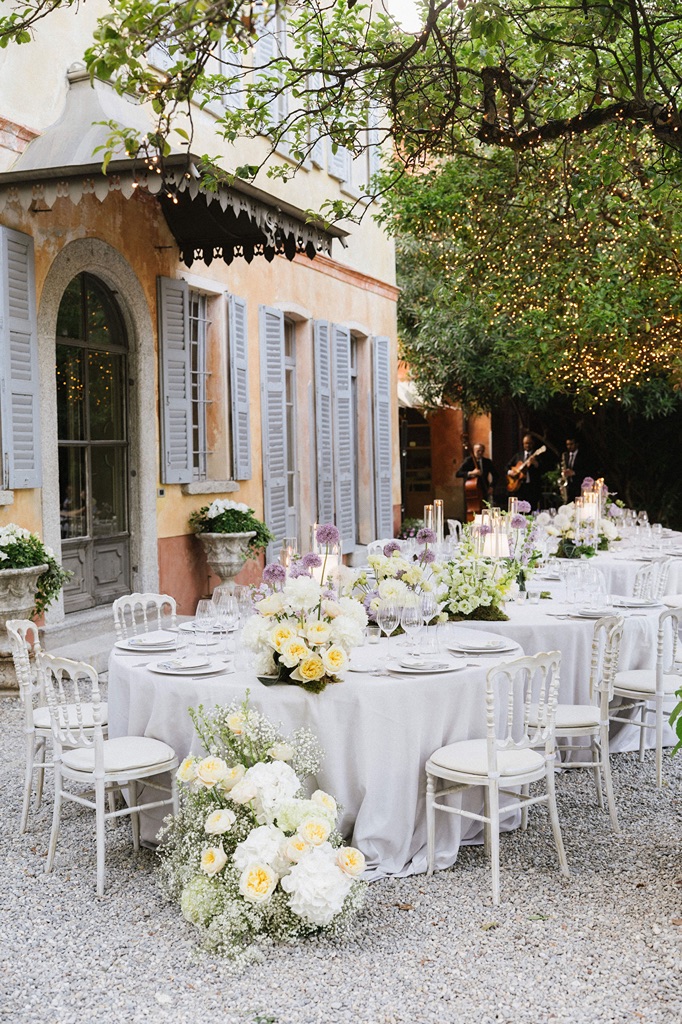
The tables. Family style works best on long tables, where platters can be shared along the length and the room reads as a single gathering. Round tables can work, as long as they are large enough to hold the platters without crowding the place settings.
The décor. Shared dishes take up space. A family style table needs room in the center, which means lower and more contained centerpieces, or flowers placed along the edges. This is one of the reasons the decision about service should come before the design is finalized.
The staff. Each format needs a different team. Plated service requires enough waiters to serve a whole table at once. Family style needs people refilling and replacing platters throughout the meal. Stations need someone behind each point, especially where a chef is cooking to order.
The timing. A plated dinner can be planned to the minute. Family style needs more margin, because guests take their time and the conversation takes over. Stations depend on how many guests move at once. Whatever you choose, the timeline of the day has to make room for it.
You Don’t Have to Choose Just One
Some of the most successful dinners mix formats within the same evening. An aperitivo built around stations, a starter served on the plate, a main course brought to the table to be shared, and a dessert that becomes another moment of movement. Each part of the meal gets the format that suits it best.
The same principle applies to a wedding that lasts a whole weekend. The welcome dinner can be the relaxed, convivial evening where family style feels natural and guests get to know each other. The wedding dinner itself can be more structured, with the rhythm that speeches and the first dance need. The farewell brunch can return to something informal. Changing the format from one event to the next also keeps the weekend from feeling repetitive.
How to Decide
When couples ask me which format is right for them, I answer with a few questions.
- How well do your guests know each other? If your guest list brings together groups that have never met, family style does a lot of the introductions for you.
- How many moments need everyone’s attention? Speeches, toasts and rituals during dinner are easier to hold together with plated service.
- What does your venue allow? End times, kitchen space, the layout of the terrace or the garden all play a part.
- What kind of evening do you want to remember? A long, generous table full of conversation, an elegant dinner with a precise rhythm, or a room in constant movement. The answer is usually clearer than couples expect once they picture the evening instead of the menu.
If you are weighing the options for your own wedding, I would be happy to talk it over with you and help you find the format that fits the evening you have in mind.