The welcome dinner is the most underestimated evening of a destination wedding, and the one I find myself defending most often when budgets are being drawn.
It is easy to see why. It has none of the weight of the wedding day. Nobody photographs it for the album cover. It is, on paper, a dinner — and dinners can be arranged.
But something specific happens on Lake Como on the night before a wedding, and it happens only if it is designed to. Your guests have flown for eight or ten hours. They have arrived in a country most of them do not know, in a landscape that has already surprised them, and they are standing in a hotel room wondering what happens next and who they will be sitting next to for three days. What you do with that evening determines the mood your guests carry into the wedding itself.
Get it right and the wedding day begins with a room full of people who already know each other. Get it wrong, or skip it entirely, and the first two hours of your reception are spent doing the work the welcome dinner should have done.
What the Evening Is Actually For
Before the ideas, the purpose — because every good decision follows from it.
The welcome dinner has three jobs. It introduces two families and two sets of friends to each other in a low-stakes setting. It gives guests their first real experience of Italy, which will shape how they remember the whole trip. And it releases the pressure that has been building since they landed, so that by the wedding day nobody is still in transit, mentally or otherwise.
None of those jobs requires grandeur. All of them require intention.
The mistake I see is treating the welcome dinner as a smaller version of the wedding — same aesthetic, same formality, same seating logic, thirty per cent of the budget. It ends up feeling like a rehearsal, which is exactly what it should not feel like. The welcome dinner works best when it is a different register entirely: warmer, looser, more local, more obviously Italian in the way an Italian family evening is Italian.
Where the Evening Happens
On Lake Como, the location does most of the work. These are the settings I return to, and what each one gives you.
- A lakeside terrace at sunset. The most reliable choice, and the one that produces the reaction couples are hoping for. The light on the lake between seven and nine in the evening is the reason people come here, and a terrace dinner puts your guests inside it rather than looking at it through a window. The practical requirement is timing: the meal has to be built around the light, not the other way around, which usually means an aperitivo at the moment the sun drops behind the mountains on the western shore and dinner served after.
- A private villa garden. Quieter, more intimate, entirely yours. A villa garden lets you seat forty people at one long table under trees strung with lights, which is a different experience from three tables of twelve in a restaurant. It also removes the constraint of a restaurant’s other diners and its closing time. The trade-off is that everything has to be brought in — catering, staff, lighting, furniture — so it is a production rather than a booking.
- A working trattoria or osteria taken over entirely. My favourite option for couples who want the evening to feel unmistakably local. A family-run restaurant in Lenno, Varenna or Sala Comacina, closed to the public for the night, serving what they actually cook rather than a wedding menu. The food is better, the atmosphere is unforced, and guests come away feeling they have eaten in Italy rather than at an event. It is also, frequently, the least expensive of the good options.
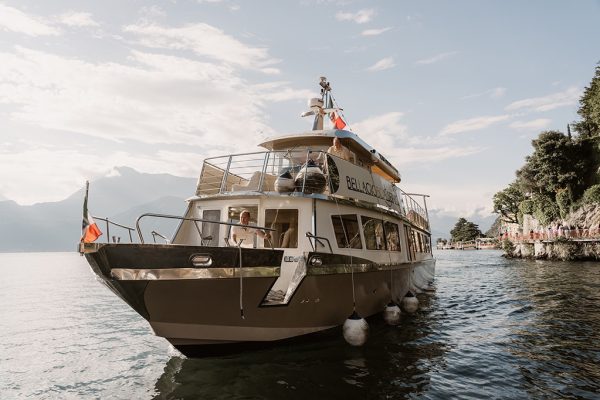
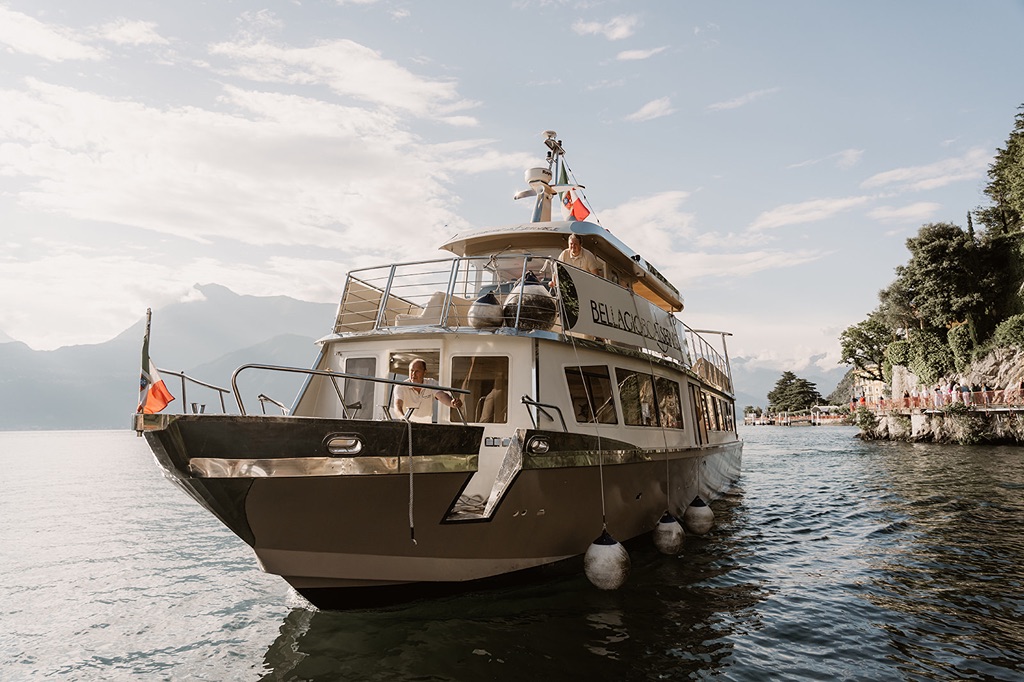
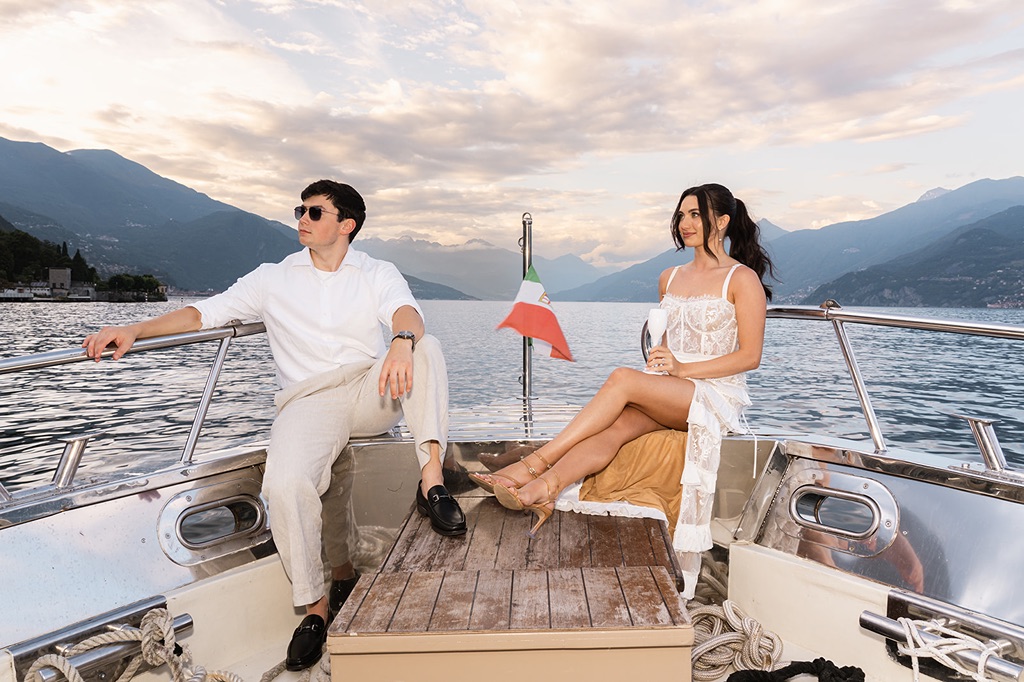
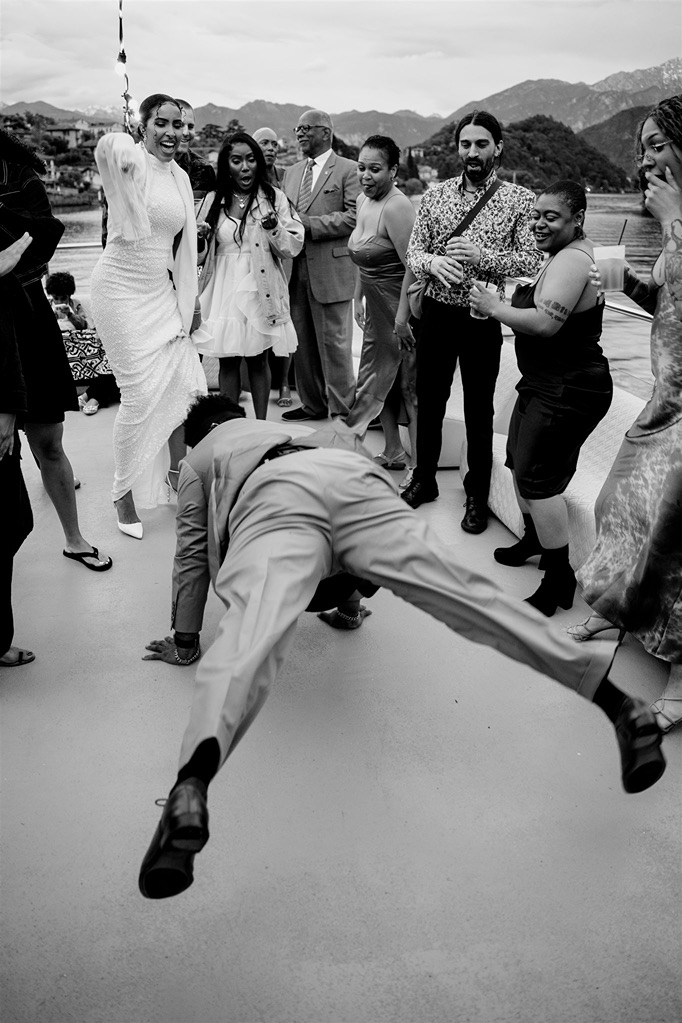
- A boat. A private boat dinner, or a boat aperitivo followed by dinner ashore, gives you the single most memorable arrival of the entire weekend. Guests board in Bellagio or Tremezzo, cross the water in the last of the light, and step off somewhere they could not have reached by road. It requires real coordination — boarding a large group, weather contingency, the return crossing in the dark — but as an opening statement for a wedding weekend it is difficult to beat.
- A cantina or wine estate. Slightly further from the water, and worth the drive. A long table in a cellar or among the vines, a tasting that doubles as an icebreaker, and a host who talks about the wine. It gives guests something to do in the first hour, which matters enormously in a room where half the people have never met.
The Ideas That Actually Change the Evening
Setting aside the venue, these are the choices that make the difference between a pleasant dinner and one guests reference for years.
- Design the first thirty minutes deliberately. This is where welcome dinners are won or lost. Guests arrive nervous, in groups they already know, and left alone they will stay in those groups all night. An aperitivo with something happening — a bartender making negronis to order, a spritz station, a cheese and salumi table people have to walk to, live music that is quiet enough to talk over — gives everyone a reason to move and something to talk about. A seated welcome with a glass handed to each arrival does the opposite.
- Seat people, and seat them strategically. There is a persistent belief that welcome dinners should be unseated because they are informal. In my experience unseated welcome dinners produce exactly the segregation you are trying to avoid: his family at one end, her friends at the other, and the two groups meeting for the first time at the wedding. Assign seats, mix the tables deliberately, and put the natural connectors — the talkative cousin, the friend who knows everyone — where they will do the most good.
- Serve food that could not be served at home. The wedding menu will be refined, plated and formal. Let the welcome dinner be the opposite: family-style platters passed along the table, the lake’s own lavarello or missoltini, a risotto brought out in the pan, pizzoccheri from the valleys north of the lake, olive oil that tastes of somewhere. Guests remember the meal that was regional far more than the meal that was elegant.
- Say something short. One toast, from one person, lasting two minutes. It marks the beginning of the weekend and it gives the evening a shape. Long speeches belong to the wedding day, and attempting them the night before dilutes both.
- Include a small gesture of orientation. This is the moment to hand over the practical information that stops guests from worrying: a printed card with the next day’s timings, where the transfers leave from, what to wear, what the weather is likely to do. It takes two minutes and it removes a hundred individual questions. If you have prepared welcome bags, some couples deliver them to hotel rooms before arrival and some place them at each seat at the welcome dinner — the second option turns the bags into part of the evening rather than a discovery in a hotel room.
- Let it end early. The temptation is to let the welcome dinner run. Resist it. Guests are jet-lagged, the wedding is tomorrow, and an evening that ends at eleven with everyone wanting more is a far better prelude than one that ends at two with three people asleep in a corner. If a group wants to continue, arrange a bar in advance and let them find it.
The Practical Constraints Worth Knowing
A few things about Lake Como specifically that shape what is possible.
Restaurants in the lakeside villages are small. A restaurant that can seat eighty for a private event is rare; most of the beautiful ones seat forty to fifty at a stretch. This is usually the first constraint that decides the venue, and it is worth establishing your guest count before falling in love with a location.
Transfers matter more than they seem to. Your guests will be spread across several hotels in several villages, and the roads along the lake are narrow and slow. A welcome dinner across the water from where most guests are staying is entirely possible but requires organised transport, not the assumption that people will drive themselves. I have written separately about how transportation on the lake actually works, and the welcome dinner is the first evening it is tested.
Weather requires a real plan, not an optimistic one. A terrace dinner in May or October is beautiful and it is also, some years, rained on. Every outdoor location should come with an indoor alternative you would be genuinely happy with, confirmed in advance, and the decision point should be agreed with the venue before the week of the wedding.
And the timing of sunset changes everything about how the evening is scheduled. In late June the light holds past nine; in early October it is gone by seven. The same terrace produces two completely different evenings depending on the month, and the schedule has to be built backwards from that.
What It Adds Up To
The best welcome dinners I have organised had almost nothing in common visually. One was a long table in a garden with a hundred candles and nothing else. One was a boat crossing at seven in the evening with a bar on the deck. One was a family restaurant in a village of four hundred people where the owner’s mother made the pasta.
What they shared was that somebody had thought about how the evening would feel rather than how it would look, and had designed the first half hour with the same care as the last.
By the time those guests arrived at the wedding the following afternoon, the introductions had already happened, the nervousness had gone, and the day could simply begin.
That is what the evening is for, and it is worth doing properly.