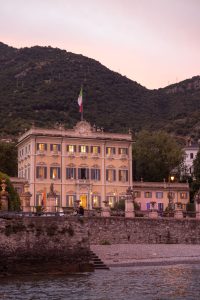
Most American couples who contact me arrive with a picture already formed. A villa above the water. A long table under the wisteria. Light that does something to photographs that no lighting designer can replicate. Almost always, that picture is accurate — Italy really does look like that, and the weddings really are that beautiful.
What tends to be missing is everything underneath the picture. Not the aesthetics, which couples usually understand very well, but the mechanics: how the country actually works in August, how far apart things really are, what a historic villa can and cannot do late in the evening, and how much of the planning has to happen a year earlier than they expect.
None of what follows is a reason to reconsider Italy. It is simply what I find myself explaining in almost every first conversation, and what tends to make the difference between a wedding that feels effortless and one that runs on adrenaline.
The Assumption That Summer Is the Right Season
This is the assumption I question most often, and the one couples are most surprised to have questioned.
Summer feels like the natural answer. It is when guests can travel, when the days are longest, when Italy looks the way it looks in the films. But the Italian summer of 2026 is not the Italian summer of 2006, and pretending otherwise does couples no favours.
A changing climate has made heatwaves a structural feature of the Italian summer rather than an occasional event, and European travel bodies now report a steady movement of visitors towards spring and autumn as a result. For a wedding, the consequences are practical: historic villas are protected buildings, so air conditioning is often limited or simply absent, guests are in wool suits and structured dresses, and the country’s instinct is to close the shutters and slow down rather than to refrigerate the building.
And then there are the roads. Lake Como is shaped like an inverted Y, with a single main road threading along each shore through villages, tunnels and stretches barely wide enough for two cars. In July and August that road absorbs the entire summer tourist flow. A transfer that takes twenty minutes in May can take an hour on a Saturday afternoon in August — and it will do so unpredictably, which is worse than doing so reliably.
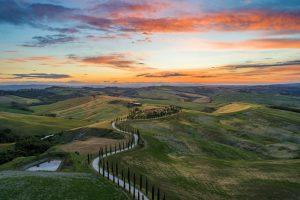
Tuscany presents the same problem in a different form. The countryside is reached by roads that curve, climb and narrow, often finishing with a stretch of unpaved strada bianca through the vines. The medieval towns were built for carts and are entered through a gate, not a parking lot. In high season, coach traffic, tour groups and August visitors fill exactly the same routes your guests will be using. The distances look modest on a map, and they are — but the times are not what the map suggests.
What Late Spring and Early Autumn Actually Give You
I raise this not as a compromise but as an upgrade, and the couples who take it rarely regret it.
- Availability. The most sought-after villas on Lake Como are booked eighteen months ahead for peak summer Saturdays. In late September and October, the same venues have space, and so do the photographers, the florists and the musicians you actually want. You are choosing from the full field rather than from what remains.
- Cost. Peak-season pricing applies to venues, accommodation, transfers and vendors alike. Moving outside it changes the arithmetic of the entire wedding, often significantly — and that budget tends to reappear somewhere guests can feel it.
- The lake itself. This is the argument I find most persuasive. In October the ferries are quiet, Bellagio is walkable, the restaurants have tables, and a boat out at five in the afternoon is an experience rather than an exercise in traffic management. Guests who have travelled thousands of miles get to encounter the place rather than the crowd around it. Couples describe it, almost without exception, as having the lake to themselves.
- The light and the colour. Autumn on the lake is a photographer’s season. The light lengthens and softens, the mountains hold mist in the mornings, and the vegetation on the slopes turns through copper and gold. It is a more cinematic palette than high summer’s flat brightness, and it photographs beautifully against stone, water and candlelight.
- The rhythm of the day. In milder weather nobody retreats indoors in the afternoon, dinner runs later and people dance longer. The whole day expands rather than being managed around the conditions.
The honest counterpoint: shoulder seasons carry more weather variability, and a credible wet-weather plan is not optional. That plan costs money — a proper marquee, a covered terrace, a venue with an interior worth using. It should be budgeted from the beginning rather than negotiated in a panic in week two. In exchange, you get a wedding that isn’t fighting the conditions.
The Myth That Going South Means Going Hotter
American couples often reason geographically: Lake Como and the northern lakes must be the cool option, Puglia and Sicily the hot one.
The reality is more interesting. The south does reach 40°C, and it does so regularly. But it is a coastal, ventilated heat — sea breezes in the afternoon, meaningful cooling after sunset, buildings designed over centuries around thick walls, shade and cross-ventilation. An evening reception in Puglia in September is frequently more comfortable than one in the Lombard plain in the same week.
The north, by contrast, produces what Italians call afa: humid, motionless air trapped in a basin enclosed by the Alps and the Apennines, which the lakes and rivers only add moisture to. The thermometer may read several degrees lower. The body reads it as worse.
The useful variables are not latitude but altitude, exposure to wind, proximity to open water and the design of the building itself. A hillside venue in Tuscany with an evening breeze can be more comfortable than a lakeside villa in a sheltered bay. This is exactly the kind of judgement a planner who knows the specific venues should be making with you, rather than a rule you can apply from a map.
Transport Does Not Work the Way You Expect
I have written separately about how to organise guest transportation in Italy, so I will keep this brief — but the assumptions matter.
The underlying point applies everywhere in the country, not only on Lake Como. Italian roads were laid out long before cars existed and have been adapted around them ever since. There is no grid, very little parking, and almost no relationship between the distance on a map and the time it takes. A venue thirty kilometres away can be forty-five minutes in one direction and ninety in the other, depending on the road, the season and the hour. Guests who mentally translate an Italian itinerary into American driving terms will get it wrong, and they will get it wrong on the day it matters.
There is no Uber in Italy in the sense Americans mean. What exists is Uber Black, a premium chauffeur service available in a handful of major cities and operating under strict licensing rules. There is no UberX, no surge of drivers three minutes away, and no reliable coverage in the villages around the lake. Guests who plan to “just get an Uber back to the hotel” at midnight will discover this at midnight.
Taxis exist but are not abundant, cannot be hailed on the street in the way they can in New York, and need to be booked. Public ferries are lovely and genuinely useful, but they stop running earlier in the evening than guests assume, and the last departure is not a suggestion. Full-size coaches cannot physically reach many of the most beautiful villas and farmhouses, whether on the lake or in the Tuscan hills, which means fleets of minivans rather than a single bus. And guests who intend to rent a car should understand ZTL restricted zones, the near-total absence of parking in historic centres and lakeside villages, and Italy’s low legal alcohol limit before they commit to the plan. An American-sized rental on a Tuscan country lane or a Como shore road is not the freedom it appears to be.
None of this is a problem when it is carefully planned with your wedding planner. All of it is a problem when it is assumed.
The Paperwork Is Not a Formality
A legally binding civil marriage in Italy requires American citizens to produce an Atto Notorio, sworn before an Italian consulate in the United States with two witnesses, and a Nulla Osta, obtained in person at a US consulate in Italy — for a fee, by appointment, on days the consulate chooses to offer them. Names must match across passports and both documents exactly. The process typically involves multiple visits to the town hall, translations, and revenue stamps.
It is entirely manageable. It is also nothing like signing a licence at a county clerk’s office the week before.
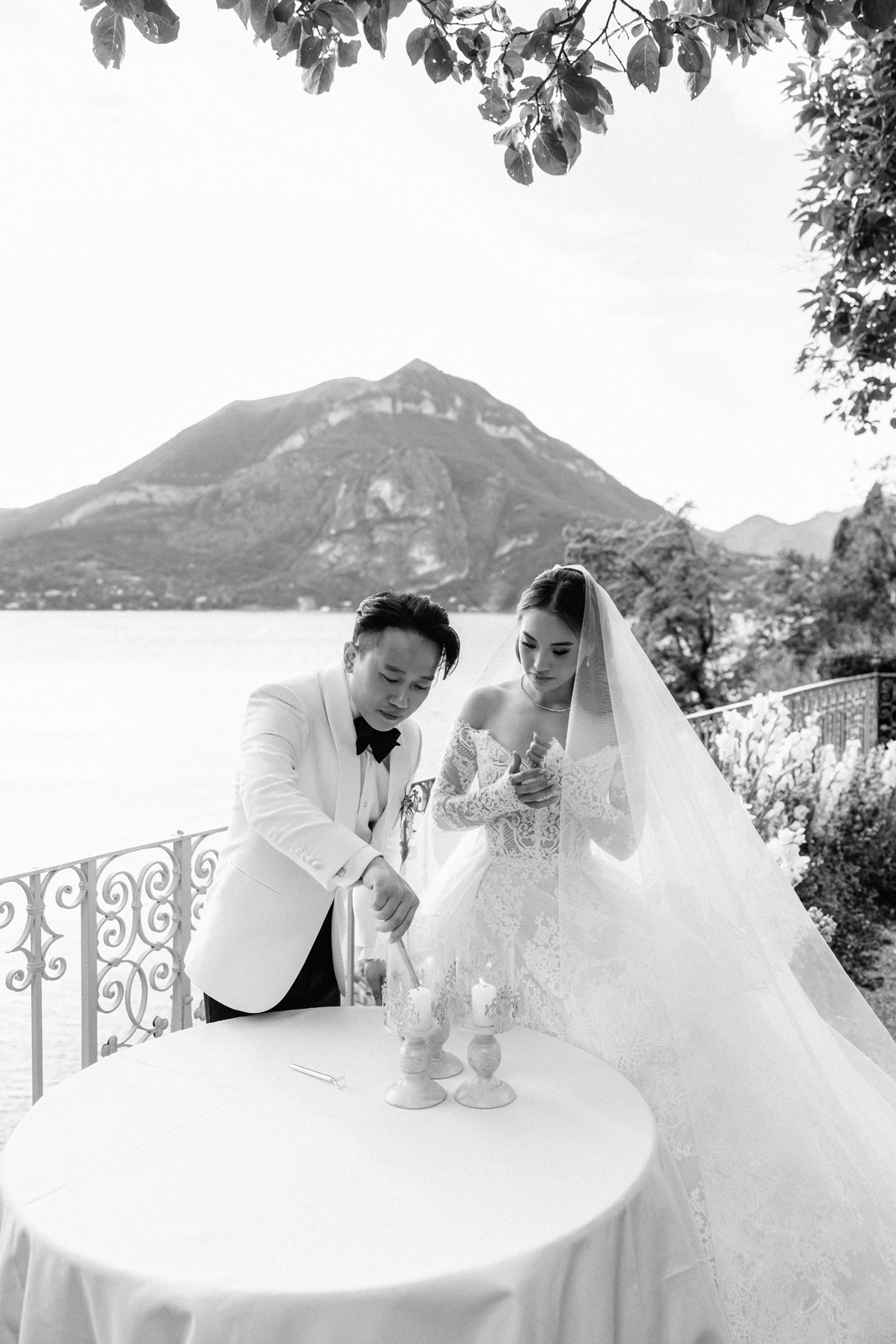
This is why a large proportion of international couples complete the legal marriage quietly at home and hold a symbolic ceremony in Italy — which can take place anywhere, at any hour, with any officiant, in a garden or on a terrace or on a boat, with none of the constraints that bind a civil ceremony. It is the option I recommend most often, and guests never know the difference.
The Day Runs on a Different Clock
Two things surprise American couples about the shape of an Italian wedding day.
The first is that dinner is long. Genuinely long. An Italian reception dinner is a sequence of courses served at a pace designed for conversation, not efficiency. Couples who plan a tight timeline of speeches, dances and cake around it are usually rebuilding that timeline by the second course.
The second is that the end of the evening is a variable rather than a given. Every venue has its own rules about how late music can play, where it can play, and at what volume — shaped by the building, its neighbours and its agreements with the local authority. Some properties are entirely relaxed about it. Others are not. These are among the first questions worth asking of any venue you are seriously considering, because the answer determines the shape of the whole evening.
Where there is a limit, the solution is simply to design the second act in advance: an indoor space, a boat, a hotel bar, a private room booked for whoever wants to keep going. Left unaddressed, the evening stops rather than ends, which is a different feeling entirely.
The Smaller Things That Aren’t Small
August is not the month it appears to be. In the resort towns, on the lake and across the Tuscan countryside, restaurants and hotels are open and working at full capacity — this is their season. What pauses is everything behind the scenes. Around Ferragosto on 15 August, suppliers, workshops, artisans and offices close for two or three weeks, decisions wait, and the people you need are away. It is a difficult month to plan in, and the most crowded and most expensive one to celebrate in.
Working relationships are built differently. The best Italian suppliers are exceptional, and many of them work as much through personal relationships as through formal process. Conversations happen by phone as often as by email, and an introduction from a planner they already trust opens doors that a cold enquiry does not. It is a way of working that rewards being properly connected locally, which is one of the quieter reasons a planner based here makes a difference.
Your guests will be spread out. There is no single resort with three hundred rooms. Guests will be distributed across boutique hotels in three or four villages, sometimes on opposite shores. Room blocks, arrival information and transfers all have to be built around that reality.
The open bar is not the default. Italian weddings are built around wine at the table, a well-made aperitivo and a cocktail hour with intent, rather than a bar running continuously from six until close. That can absolutely be arranged, and often is. It simply has to be specified rather than assumed.
Exclusivity has to be confirmed. Not every venue holds one event per day. If you are imagining the villa entirely to yourselves, that must be written into the contract.
What All of This Actually Means
Every point above is manageable. Most of them are only difficult when they are discovered late — when the venue is already booked for the second Saturday in August, when the timeline has been built around a 2am finish, when fifty guests are waiting for cars that were never arranged.
Planned early, these constraints stop being obstacles and start shaping something better: a September wedding on a lake that belongs to you for the weekend, a dinner that unfolds at its own pace, guests who arrive without ever having had to solve a problem.
That is the difference a year of thinking ahead makes, and it is most of what I do.