Every wedding has a timeline. Very few couples realise that in Italy the timeline is not an administrative document but a design decision, and probably the most consequential one they will make about the day itself.
The reason is simple. An Italian wedding day is governed by three things that cannot be negotiated with: the sun, the food, and the point at which the music has to stop. Everything else can be moved. Those three cannot, and a day built in ignorance of them spends its entire length trying to catch up with itself.
Couples who understand this early end up with a day that seems to unfold on its own. Couples who do not end up with a day that is being managed, visibly, in front of their guests.
The Day Is Built Backwards From the Light
The first thing I establish with any couple, before menus and long before flowers, is what the sun does at that venue in that month.
Not approximately. Precisely. What time it drops behind the ridge on the western shore of the lake. What time it stops falling on the terrace. What time the sky goes gold and what time it goes dark.
That single set of times determines almost everything else.
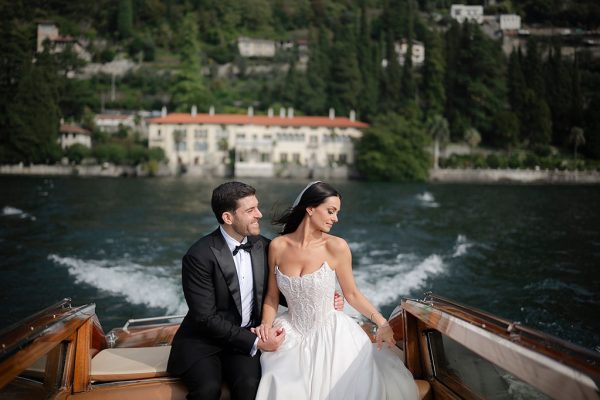
It determines when the ceremony is, because a ceremony held at two in the afternoon in July puts your guests in full sun in formal clothing, and a ceremony at six puts the couple in front of low, warm, forgiving light. It determines when the aperitivo is, because there is a specific half hour on Lake Como when the light comes off the water and everyone reaches for their phone. It determines when dinner is served, because dinner served too early runs out of daylight halfway through and dinner served too late loses the transition entirely.
And the times move enormously across the season. In late June the light holds past nine in the evening. In early October it has gone by seven. The same venue, the same design and the same schedule produce two completely different weddings four months apart, which is why a timeline copied from a wedding in another month is worse than no timeline at all.
The other consequence is that the photographs everyone actually wants sit inside a window of roughly forty minutes. If the timeline does not deliberately place the couple in that window, it will pass while everyone is between courses.
Dinner Is Longer Than You Think, and That Is the Point
The second immovable object is the meal.
An Italian reception dinner is a sequence: aperitivo, antipasti, a first course, a second course, then dessert and cake. Served properly, at the pace it is meant to be served, that is two and a half to three hours. It is not slow service. It is the structure of an Italian meal, and it is one of the reasons people love weddings here.
Couples arriving with an American timeline tend to plan around a dinner of ninety minutes, with speeches, a first dance, a cake cutting and a band change fitted neatly into it. By the second course that plan is being rewritten in real time, usually by me, usually while smiling.
There are two ways to handle it, and only one works.
The first is to compress the meal, which means rushing the kitchen, hurrying the service and removing exactly the quality that made an Italian wedding appealing.
The second is to accept the length and design around it: fewer, shorter speeches placed deliberately between courses rather than stacked at the end; a first dance that happens when dinner naturally concludes rather than at a time printed on a card; and a genuine understanding that the evening will start later and run longer than it would at home.
The second approach produces a day that feels generous. The first produces a day that feels efficient, which is not a compliment anyone has ever paid to a wedding.
One practical note that follows from this: the aperitivo before dinner is not a holding pattern. It is a full course in Italian terms, often the most sociable hour of the day, and it should be built and staffed accordingly rather than treated as the gap in which guests wait for the real event.
The length of an Italian dinner is one of several things American couples often underestimate about getting married in Italy.
The End of the Evening Is a Variable
The third fixed point is the one couples discover last, and it deserves to be discovered first.
Every Italian venue has its own rules about how late music can play, at what volume, and where. Those rules come from the building, its neighbours, the local comune and, in the case of historic properties, agreements that have existed for decades. Some villas are entirely relaxed. Others require amplified music to move indoors at midnight. Others stop altogether at one.
This is not a detail. It defines the shape of the entire evening, and therefore of the whole timeline that leads into it. A wedding that must end at midnight and a wedding that can run until three are two different days from the moment the ceremony is scheduled.
So it belongs among the first questions asked of any venue under serious consideration, alongside capacity and cost. And where there is a limit, the answer is not to fight it but to design the second act deliberately: an indoor space, a boat, a hotel bar, a private room booked in advance for whoever wants to continue. Planned, the evening ends where it was always going to end and then moves somewhere else. Unplanned, it simply stops, which feels entirely different.
The Times That Are Never in the Timeline
Beyond the three fixed points, the most common cause of a day running late is not any single event but the intervals between them.
- Getting eighty people to move. A group of eighty does not travel from the ceremony to the aperitivo in the four minutes it takes one person to walk it. Every movement of a large group needs fifteen to twenty minutes in the schedule, and there are usually four or five such movements in a day.
- Travel times that are real rather than optimistic. Twenty minutes between the church and the villa is twenty minutes at nine on a Tuesday morning. On a Saturday afternoon in August on the lake road it can be triple that, and the coach that carries the guests moves more slowly than the car that carried the planner on the site visit. It is one of the reasons transport for wedding guests in Italy belongs inside the timeline rather than beside it.
- The gap between ceremony and reception. Usually ninety minutes, usually under-designed, and the hour in which guests are most likely to be uncomfortable, hungry or unsure where to be. It needs a location, refreshments, shade and a clear instruction.
- Getting ready. The morning consistently runs over, and it runs over at the point where it is most expensive: the couple’s portrait time, which is the first thing sacrificed.
- Family photographs. A list of twelve group combinations, at three minutes each, with the time required to find the people in each one, is not twenty minutes. It is closer to forty-five, and it happens at exactly the moment the light is best.
What the Right Timeline Feels Like
A well-built Italian wedding timeline has a particular quality: it has air in it.
It is not densely packed with events. It has long stretches where nothing is scheduled, because in Italy those stretches are the wedding — the aperitivo that runs an hour longer than planned because nobody wants to sit down, the pause between courses where people move between tables, the moment after dinner when everyone drifts towards the terrace because the lake has gone dark and the candles have started to matter.
Those are the parts guests remember, and they only exist if the schedule has left room for them.
The paradox of a good timeline is that its purpose is to make the day feel unscheduled. Everything is timed precisely so that nothing has to be hurried, and so that the couple never has to look at a watch.
That is what the work is for. Not to control the day, but to ensure that on the day there is nothing left to control.