Transportation is one of those aspects of wedding planning that couples tend to underestimate — until something goes wrong.
In Italy, and particularly in destinations like Lake Como, the logistics of moving guests between locations require more thought than they might in a city or at a resort where everything happens on the same property. The roads are narrow and scenic, the distances deceptive, the traffic in high season genuinely unpredictable. A wedding where fifty guests need to travel from five different hotels to a venue on the opposite shore of the lake is a coordination challenge that deserves serious attention.
Getting it right is, in many ways, invisible — guests simply arrive on time, comfortably, without having had to think about it. Getting it wrong is the kind of thing that colours the memory of a day in ways that are difficult to undo.
The Specific Challenges of Lake Como
Lake Como has a geography that is unlike most wedding destinations. The lake is shaped like an inverted Y, and the main road that runs along its shores — the SS340 and SS583 — passes through a succession of villages, tunnels, and narrow stretches that become significantly congested during summer weekends. What looks like a fifteen-minute drive on a map can easily become forty-five minutes on a Saturday afternoon in July.
This has practical implications for every movement of the wedding day: guests transferring from their hotels to the ceremony, the couple’s own arrival at the venue, the movement between a ceremony location and a reception venue if they are different, and the return journey at the end of the evening.
Planning transportation on Lake Como requires knowing the roads, understanding the traffic patterns, and building realistic timing into every transfer. It also requires having reliable drivers — people who know the lake, who communicate well in English, and who understand the particular demands of a wedding day.
Arriving in Italy: The Airport Transfer
For international guests, the journey begins at the airport — and a well-organised arrival transfer sets the tone for the entire stay.
Milan has two main airports: Malpensa (MXP), which handles most international long-haul flights, and Linate (LIN), which serves shorter European routes. From Malpensa, the drive to the central lake area — Tremezzo, Menaggio, Bellagio — is approximately 90 minutes to two hours, depending on traffic. From Linate, it is slightly longer.
For couples who want to offer their guests a genuinely seamless arrival experience, a private transfer with an English-speaking driver is the most reliable option. It eliminates the uncertainty of public transport connections, the difficulty of navigating with luggage, and the particular stress of arriving in an unfamiliar country after a long flight.
For guests who would prefer a VIP level of service, it’s also possible to arrange a meet-and-greet service at the airport gate — where a dedicated assistant accompanies guests through customs, immigration, and baggage collection before handing them to their driver. This level of support is particularly appreciated by guests who are less experienced travellers, or who are travelling with elderly relatives or young children.
These arrival and departure transfers are something I coordinate through my trusted local partner, a boutique DMC based in Bellagio, with deep expertise in logistics on Lake Como and across Italy. Their team handles the details so that guests arrive at their hotel without having had to think about anything at all.
Moving Around the Lake
Once guests are on the lake, there are essentially two ways to get around: by road and by water.
- By road: the key is private transport. Taxis on Lake Como are not abundant, and relying on guests to arrange their own transfers independently — particularly for time-sensitive movements like the ceremony arrival — introduces a level of unpredictability that is avoidable. Coordinating a fleet of private vehicles or minivans for key moments of the wedding day gives the planner control over timing and gives guests the confidence of knowing exactly what to expect.
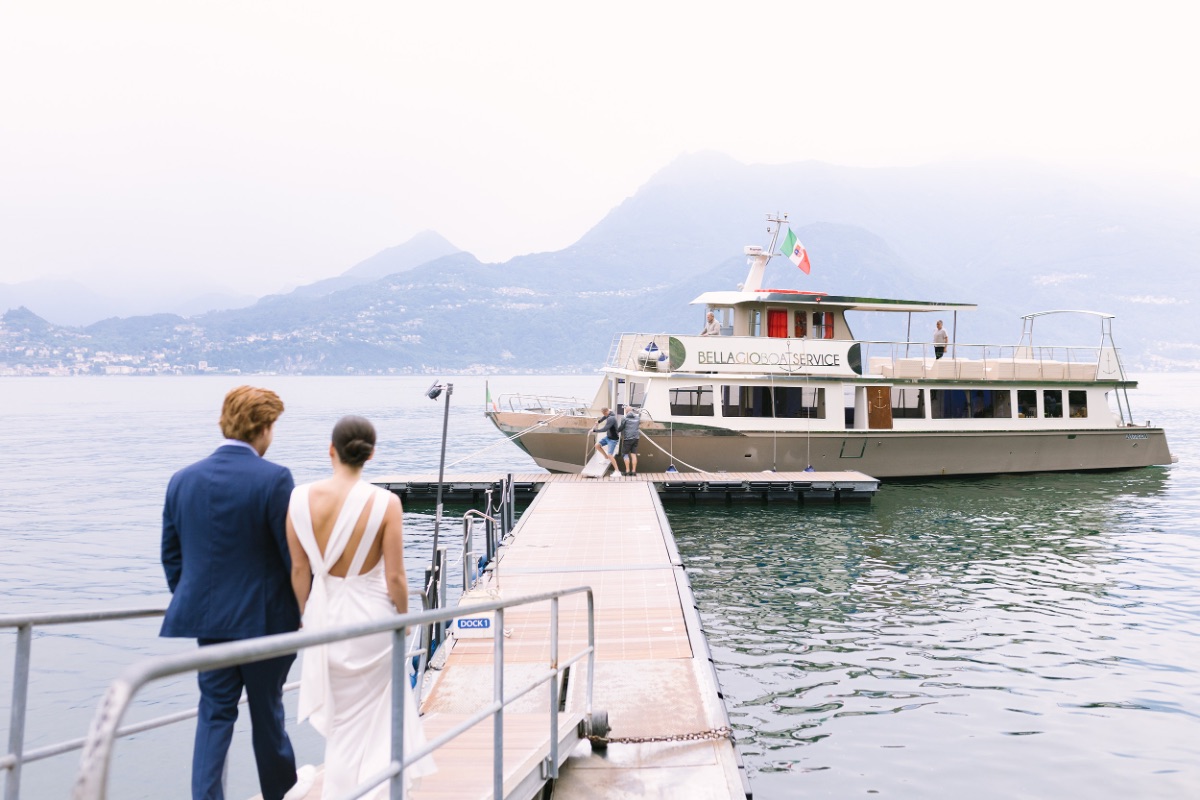
- By water: the lake offers something that roads cannot: beauty, drama, and a sense of arrival that is simply impossible to replicate by car. Arriving at a wedding venue by private boat — gliding across the water, approaching a historic villa from the lake side — is one of those moments that guests talk about for years. For couples whose venue has a landing stage, a boat transfer for the wedding party or for specific groups of guests is an investment that pays for itself in memory.
Combining the two — road transfers for the practical movements, boat transfers for the moments that deserve to be exceptional — is often the most elegant solution.
A Note on the Return Journey
The end-of-evening transfer is, logistically, the most complex part of the day. Guests are dispersed across multiple hotels, the evening has run long, and everyone is tired. This is not the moment for improvisation.
Planning the return journey requires the same level of care as the arrival. Clear communication to guests about departure times, a coordinator on site to manage the flow of departures, and drivers who are reliable and punctual — these are the elements that ensure the evening ends on the same note it began.
It’s also worth thinking about guests who may want to extend the evening independently — and ensuring that information about local taxi services, water taxi options, and last boat times is communicated clearly and in advance.
Making It Feel Effortless
The goal of all of this is the same as the goal of every other aspect of wedding planning: that guests feel looked after without feeling managed. That the logistics are invisible. That the experience of moving through the wedding day — from their hotel to the ceremony to the reception and home again — is smooth, comfortable, and occasionally beautiful.
If you’d like to understand how transportation for your Lake Como wedding might work in practice, I’d be happy to talk through the specifics.