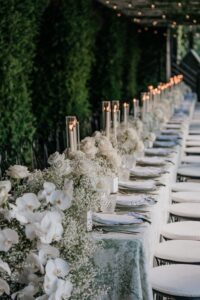
Couples usually begin the search for a Tuscan venue with a folder of photographs, and by the third week the photographs have started to look the same. A stone terrace. A cypress avenue. A long table with candles. Somewhere, in every image, a view that goes on for miles.
The images are not misleading. Tuscany really does look like that, and a great many of its venues are genuinely beautiful. But because they are beautiful in similar ways, photographs are a poor tool for choosing between them, and couples who choose from images alone frequently end up somewhere lovely that does not do what they wanted.
The more useful question is not which property is the most romantic. It is what kind of countryside you want to get married in, and what kind of building you want to spend three days inside. Answer those two and the field narrows very quickly.
First: Which Tuscany?
Tuscany is not one landscape. The differences between its regions are significant, and they produce visibly different weddings.
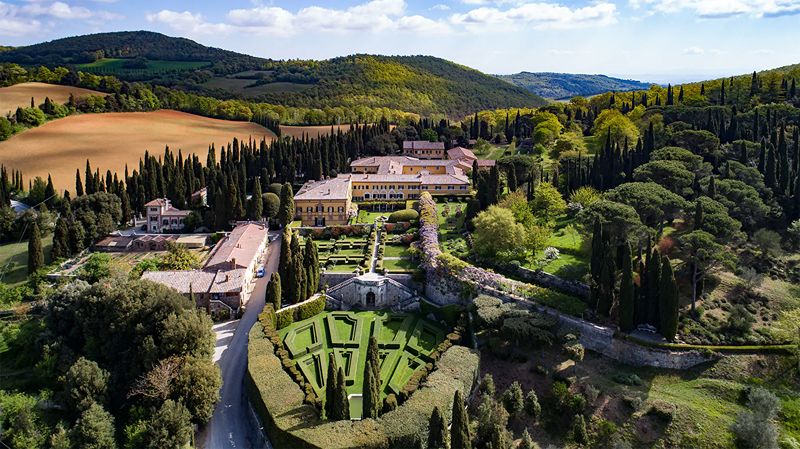
The Val d’Orcia, south of Siena, is the Tuscany of the photographs: bare rolling hills, solitary cypresses, wheat fields that turn gold in June and green again in autumn, and a horizon that seems drawn rather than grown. It is the most cinematic option and, correspondingly, the most sought-after and the most exposed to the summer sun. Venues here are often isolated, which is part of the appeal and a real logistical consideration. La Foce is the reference point: an estate whose gardens, designed by Cecil Pinsent for Iris Origo in the 1920s, are among the most photographed landscapes in Italy.
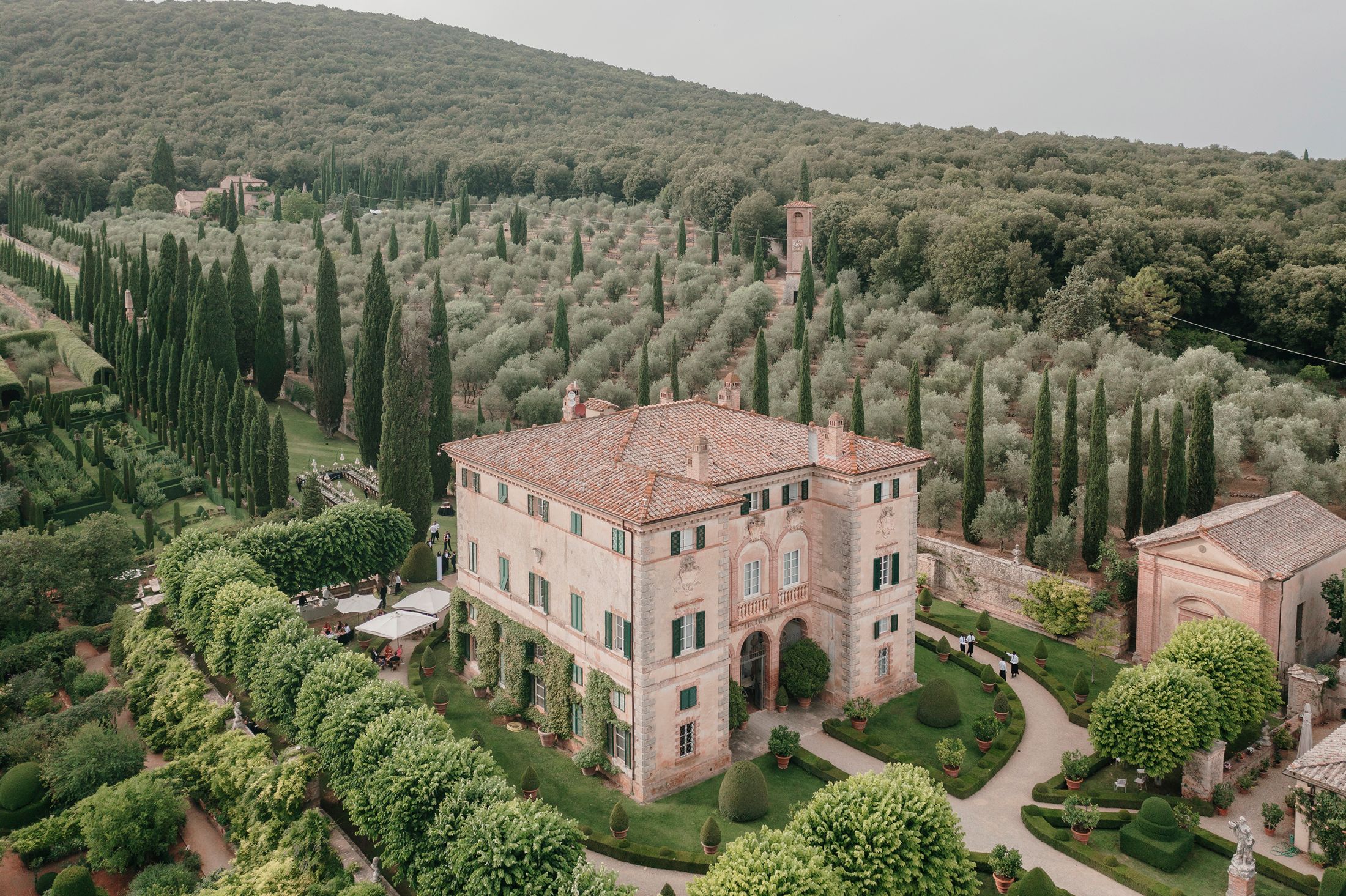
Chianti, between Florence and Siena, is greener, denser and more enclosed. Vineyards, olive groves, oak woods, stone hamlets on ridges. It feels lived-in rather than sculptural, and it is the natural choice for couples who want wine at the center of the weekend. It also has the practical advantage of being close to Florence, which matters for guest arrivals. Villa di Geggiano, near Siena, has belonged to the same family since 1527, and its frescoed rooms and baroque outdoor theatre give a wedding an unmistakable sense of continuity with the past.
The hills around Siena are a category of their own, and the one most couples miss. This is the Montagnola Senese: wooded, cooler than the open valleys, and dense with properties built by families who wanted to be near the city without being in it. Villa Cetinale, built for Pope Alexander VII in the seventeenth century and later home to Princess Margaret and Mick Jagger, carries a weight of history few venues anywhere can match, and its Baroque gardens are among the most celebrated in Italy. Castello di Celsa, along the same hills, has passed through the De Vecchi, Antinori and Aldobrandini families and has a sixteenth-century chapel designed by Baldassarre Peruzzi.
The hills above Florence give the most formal version of a Tuscan wedding, with the city itself within reach for guests. Villa Gamberaia offers a Renaissance garden considered one of the finest examples of Italian landscape design in the world, framing a view over Florence and the Arno valley. Villa Medicea di Lilliano and Villa Corsini a Mezzomonte share Medici origins and the scale to match: Lilliano within its own vineyards and olive groves, licensed for legal ceremonies on site; Corsini across twenty thousand square meters of gardens.
The hills around Lucca and Pistoia, in the north-west, are softer and more wooded, with grand villas and formal gardens rather than working farms. This is the Tuscany of eighteenth-century summer estates, and it produces a more classical, more manicured wedding. It is also cooler in summer and closer to Pisa airport.
San Gimignano and the Val d’Elsa sit between the two, with medieval towers on the skyline and a landscape of vines and cultivated valleys. Very beautiful, very well served with venues, and slightly less booked than the Val d’Orcia.
The Maremma, in the south-west, is Tuscany’s least-known corner: wilder, flatter, coastal, with pine forests, horses and the sea within reach. Couples who want Tuscany without the postcard, and who like the idea of a beach on the Sunday, should look here.
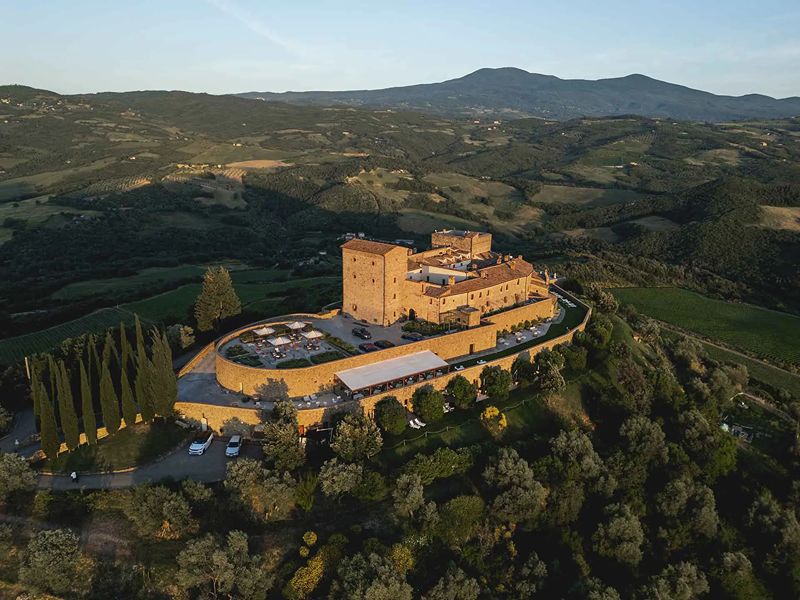
Montalcino and Montepulciano offer the Val d’Orcia landscape with serious wine estates attached, and some of the best food in Italy within twenty minutes of the venue. Castello di Velona, on a hilltop above Montalcino, is the only castle in the world built on natural thermal water, and its spa and dining give guests a reason to arrive early and stay late.
Choosing the region first is the most efficient decision in the whole process, because it eliminates two thirds of the venues before you have looked at a single one.
Second: Which Kind of Building?
The other axis is the property itself, and there are essentially four kinds.
The historic villa. A grand house, usually sixteenth to eighteenth century, with formal gardens, a limonaia, statuary and a certain amount of ceremony built into the architecture. It gives the most elegant version of a Tuscan wedding, closest in register to a wedding on Lake Como. Rooms on site are often limited, and heritage restrictions on what can be installed are usually significant.
The borgo. A restored hamlet — a cluster of stone houses, a small piazza, sometimes a chapel, sometimes a former church — held in single ownership and rented as a whole. This is my favorite category for a multi-day wedding, because a borgo gives you a village to occupy. Guests have their own front doors, there is a square to gather in, and the whole party can stay on site. It produces the closest thing to a wedding that has taken over a small town.
The working estate or azienda agricola. A functioning wine or olive farm with accommodation and event space. Less polished than a villa, more authentic, and usually the best food and wine of any category because it is produced where you are standing. The aesthetic is honest rather than grand, and it suits couples who want a wedding with the countryside in it rather than a wedding with a view of the countryside.
The restored farmhouse or casale. Smaller, more private, and ideal for weddings of forty to seventy guests. A single stone house with a pool, a pergola, an olive grove and a view, entirely yours for the week. It gives the most intimate version of Tuscany and the greatest sense that you are staying in a home rather than at a venue.
What Actually Makes a Countryside Venue Romantic
Setting photographs aside, these are the features that consistently produce the feeling couples are looking for.
A single, uninterrupted view. Not a panoramic terrace with a car park below it. A view from the dinner table with nothing in it that belongs to this century.
An avenue of approach. The best Tuscan properties are reached by a long cypress-lined drive, which turns the arrival into an event. It matters more than it sounds like it should.
Somewhere shaded to gather. A pergola, a loggia, a courtyard with high walls, a stand of ancient oaks. In Tuscany, shade is not a comfort feature, it is the difference between guests being present and guests being indoors.
Multiple distinct spaces. Ceremony in the olive grove, aperitivo in the courtyard, dinner on the terrace, dancing in the barn. A property that offers three or four genuinely different settings gives the day a sense of progression that a single lawn cannot.
A west-facing dinner space. The Tuscan sunset is the reason to be there. A dinner table that faces it is worth more than any centerpiece.
Stone that holds candlelight. Old stone and terracotta do something particular with warm light after dark. It is the single most reliable atmospheric effect available in Tuscany and it costs almost nothing.
The Questions to Ask Before You Fall in Love
Every one of these has changed a couple’s shortlist at least once.
Can you have exclusive use, and for how many days? Some properties host one wedding at a time. Others do not. Some include the day before for setup and some charge for it.
How many guests can sleep on site? This is the question that most often decides a Tuscan venue, because the whole appeal of the multi-day wedding depends on it. Forty beds and eighty guests is a transport plan you were hoping to avoid.
What time does the music have to stop, and where? Rural does not mean unrestricted. Neighbors, the comune and the property’s own agreements all apply, and the answer shapes the entire evening.
Where does the catering actually happen? Many beautiful properties have no professional kitchen, which means a mobile kitchen is brought in and positioned somewhere. Ideally somewhere you cannot see or hear.
What is the road like? If the final kilometer is an unpaved strada bianca, coaches cannot use it, elderly guests will feel every meter of it, and deliveries become more complicated. This is not disqualifying, but it must be known.
Is there a genuine indoor alternative? Not a garage. A room you would be happy to have dinner in for eighty people, if it rains.
How far is the nearest town? Guests will want to go somewhere at some point during three days. Twenty minutes is charming. An hour is not.
A Note on the Names
The properties above are the ones I return to, and they are a fair illustration of what each part of Tuscany does best. They are not a shortlist.
Availability moves constantly, several of the finest options never market themselves, and a venue that is perfect for a hundred guests in June is the wrong choice for fifty in October. A name that appears in every article is also, by definition, the name every other couple is writing to.
So the sequence I work in is the reverse of the usual one. Region, building, guest count, season, the shape of the weekend you want. Then three or four properties that genuinely fit, some of which will be here and some of which will not have appeared in anyone’s folder of photographs.
That is usually a much shorter process than couples expect, and it ends somewhere better than where the search started. If you would like to start with the region and the shape of your weekend, I would be glad to walk you through it.